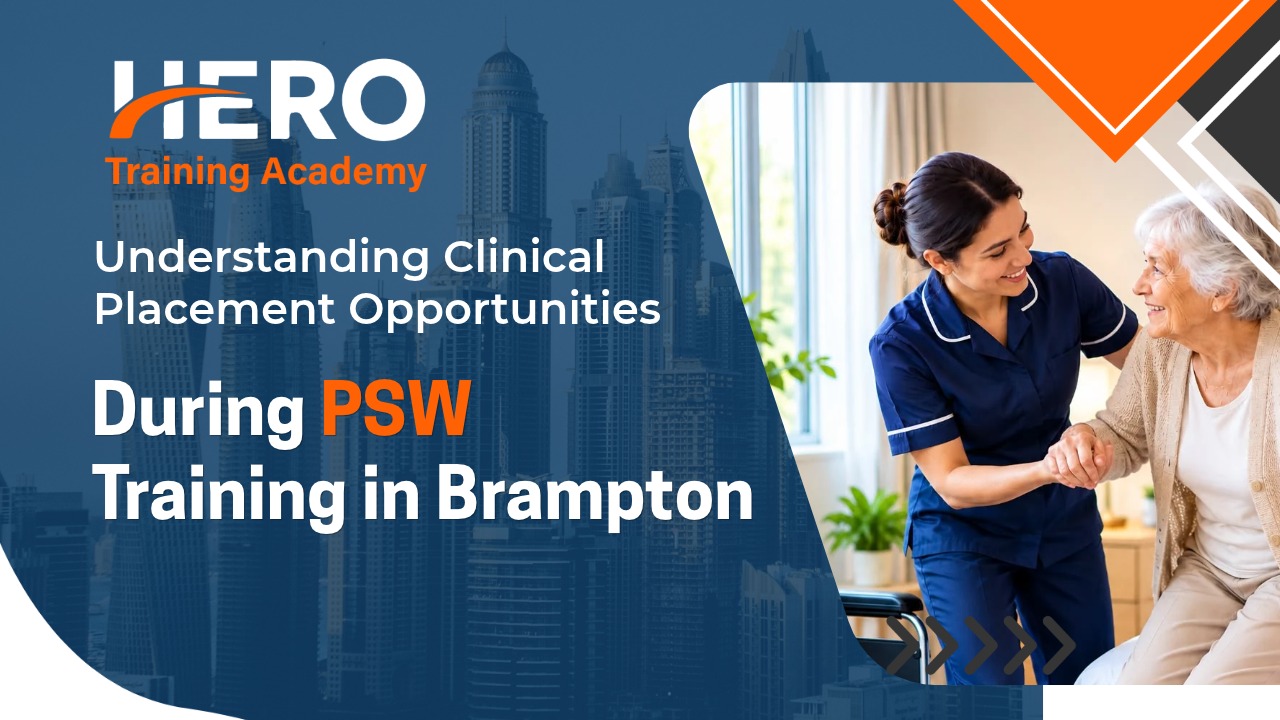
Personal Support Workers (PSWs) undergo mandatory, hands-on training called clinical training to gain practical knowledge and develop critical life-saving skills. It helps bridge the gap between theoretical learning and practical experience. Students also gain valuable experience while training under qualified healthcare professionals. Clinical training also brings placement opportunities for the Personal Support Worker Course Brampton.
What Is a Clinical Placement in PSW Training?
It is a supervised practical learning experience in which PSW students work in a professional setting, such as hospitals and clinics. The objective of the training is to help students apply their theoretical knowledge in practice. They face multiple challenges and manage critical situations to the best of their knowledge. It develops confidence and prepares them for the job.
Types of Clinical Placement Opportunities in Brampton
Long-Term Care Facilities
Long-term care homes provide clinical facilities to people who require support with daily activities. PSW students assist residents with personal hygiene, dressing, mobility, meals, and other routine needs. However, developing an understanding of person-centered care is the biggest advantage of this clinical training. Students understand what residents need and try to make their lives simple and fulfilling.
Retirement Homes
Retired persons, often couples, shift to retirement homes for care, support, and company. Many retired people suffer from chronic ailments and depend on medication. PSW students are employed to take care of retired persons living in retirement homes. Students interact with retirees. They learn how personal care can change lives.
Hospital Settings
Hospitals require trained PSWs. They hire PSW students for patient care and train them. Students work in a professional setting where they get an opportunity to learn new skills from qualified healthcare professionals, including doctors and surgeons. Hospitals also provide multiple opportunities. The best-performing PSW students even get employment opportunities from hospitals.
Community Care Settings
In community-care settings, PSW students go to patients’ homes. For example, a senior person with dementia can hire a trained PSW to take care of their daily activities. The student supports the person with dementia. Here, PSW students work outside of institutional settings. They learn many things that they wouldn’t have learned in the PSW Program Brampton.
Skills Students Develop During Clinical Placements
Direct Client Care: PSW students assist with feeding, mobility, personal hygiene, dressing, and vital signs monitoring. The important thing is they understand diets, clothing requirements, and mobility issues. They also learn to document medical records and observations.
Follow Care Plans: One of the biggest advantages of clinical training is that PSW students learn to work with healthcare teams. They practice documentation and observation skills. They follow proper care plans and prepare medical records for doctors.
Safety and Protocols: Clinical training is an opportunity for PSW students to apply emergency skills. They deal with real-life situations with real patients. They learn to assess emergencies and keep lives safe. For example, they ensure patients’ safety and security.
Why Clinical Placements Are Important
Clinical training is important for practical learning. PSW students take practical training in professional settings where they work directly with clients. They learn to prepare and discuss medical records with doctors. Clinical training also helps develop problem-solving skills. PSW students learn to assess conditions and take immediate steps to avoid emergencies.
Final Thoughts
Clinical placement is an important part of the PSW Program Brampton. It is an opportunity for students to prove their skills. Students can show their willingness to develop new skills. They learn to work in different settings and give their best. The practical training motivates and prepares them for a promising career in the healthcare sector.