Education for a child starts with their birth. An Early Childhood Education Course Mississauga prepares teachers for early childhood education. Early education isn’t about language, math, or science. It’s about cognitive development – playing mind games and developing problem-solving abilities. It can play a crucial role in the overall development of a child.
What is Cognitive Development?
It is about how a child’s mind grows, learns to think, and solves problems. The objective of early education is to assist children in achieving their developmental goals. The teachers don’t carry books, but educational games. Children also show interest in learning about things they see and use. For example, they learn about shapes, sizes, weights, and colors.
Early education supports cognitive development in many ways. Trained and certified teachers understand the foundations of child development and the need for education. They come equipped with the necessary tools to teach students. If you are a parent of a growing child, you should consider hiring a teacher for your child.
Here is how early education supports a child’s cognitive development
1. Play-Based Learning
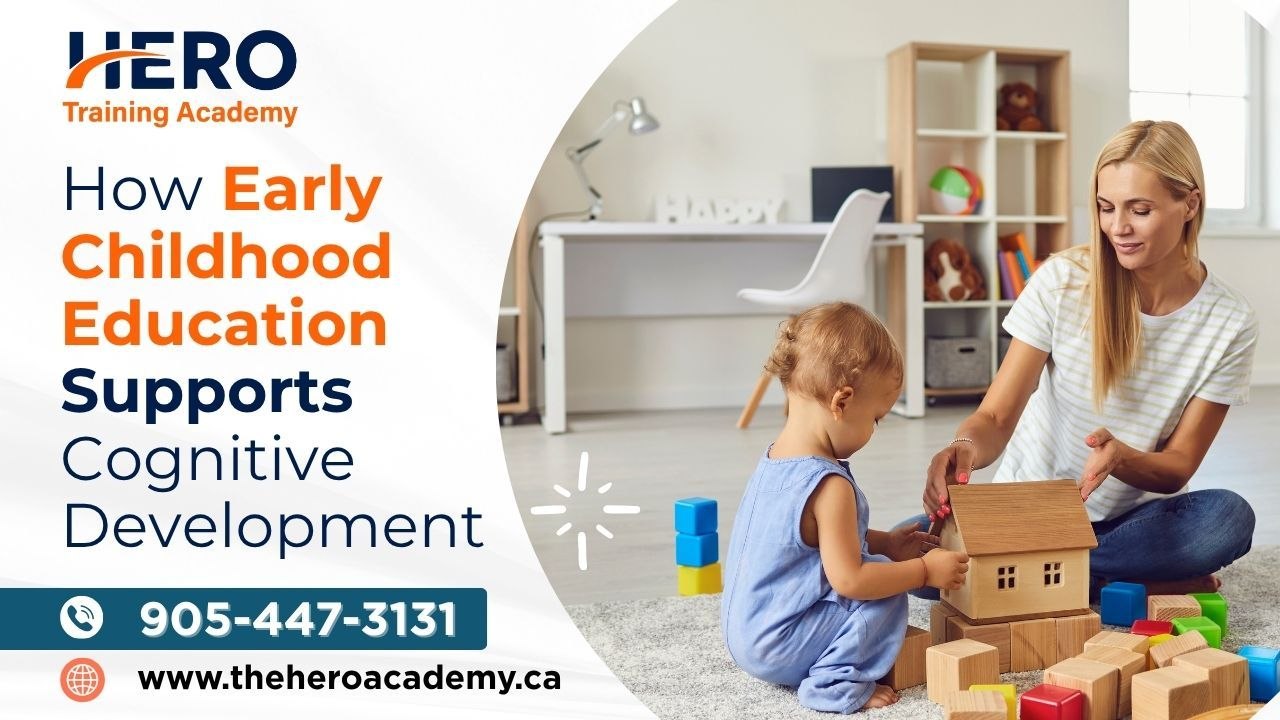
Young minds learn faster through games. They learn about various shapes and sizes while playing with building blocks. They play puzzle games and participate in role-playing activities. Trained teachers research interesting games to encourage children to play and learn. Play-based learning strengthens confidence and independence.
2. Language Development
Trained teachers help children develop language skills through storytelling sessions, poems, and general questions. They encourage students to listen carefully and answer the questions. In this way, they help children develop communication skills. Language training helps develop vocabulary, understand the meanings of difficult words, and improving the pronunciation of common words.
3. Memory and Attention
A class lasts for about an hour. In this hour, children take important lessons. They learn to develop focus and remember the lessons taught in the class. The Early Childhood Assistant Course Toronto includes memory and attention development. Children remember songs, names, routines, and discipline. These skills prepare students for formal schooling.
4. Mathematical and Logical Thinking
Children not only learn shapes and sizes, but also counting. They count how many blocks are in a building block game. They count objects, match shapes, sort colors, and identify patterns. You can say that children are introduced to mathematical concepts that help in formal school. Logical thinking helps them arrange their belongings.
5. Problem-Solving Skills
Educational games, such as building blocks, help develop problem-solving skills. For example, children think before placing blocks one over the other. They find the right block to complete the game. Similarly, they solve puzzles, find odd figures, and arrange things in sequences. The games develop reasoning, persistence, and confidence. They know every problem has a solution.
6. Creativity and Curiosity
Play-based learning encourages creativity and curiosity. For example, children become curious about things they see. They want to learn more about things, such as musical instruments, vehicles, and aeroplanes. They create stories and express their ideas in different ways. They become more willing to ask questions and interact with teachers.
7. Social Environment
ECA Course Brampton also includes the development of social skills. Children learn to interact with teachers, staff, and peers. They know how to respect others. It is an important development because it prepares them to interact with their family members, relatives, and neighbors.
Final Thoughts
Early childhood education plays a crucial role in supporting cognitive development in children. An ECA Course Brampton can prepare you for the job of an early childhood teacher. You will learn how play-based activities encourage children to develop reasoning, memory, and logical thinking.